








Table Of Contents:
Introduction
Most eCommerce stores are already doing the hard work: driving traffic, running paid campaigns, optimizing pages. However, the real conversion leaks emerge after the click.
Shoppers browse. They hesitate. They compare. Then they exit.
Not because the product is wrong, but because the buying experience isn’t guided.
An AI assistant for ecommerce is finally closing that gap. Instead of a generic catalog, shoppers get personalized journeys: smarter search, tailored product suggestions, real-time answers, and buying support that feels one-to-one, not one-to-many.
This guide breaks down seven platforms worth considering and explains why they matter in real buying journeys. There’s also a simple evaluation framework to help you compare them based on usefulness, effort required, and fit for your store.
What is an AI Shopping Assistant?
AI shopping assistants are tools that make online shopping feel more personalized and less overwhelming. Instead of clicking through endless pages, users can simply type what they’re looking for, and the assistant helps narrow down the results.
These assistants understand intent, suggest relevant products, answer common questions, and help shoppers compare options, so they don’t have to do all the work. They assist during checkout, offer alternatives if an item is out of stock, and provide quick information on returns and delivery.
Top 7 AI Shopping Assistant Platforms That Drive Personalized Shopping Journeys
Each assistant on this list plays a distinct role in enhancing the shopping experience, from facilitating faster product discovery to providing more accurate recommendations. Use this list to understand what each tool is designed for and when it actually makes sense to implement it.
ConversionBox
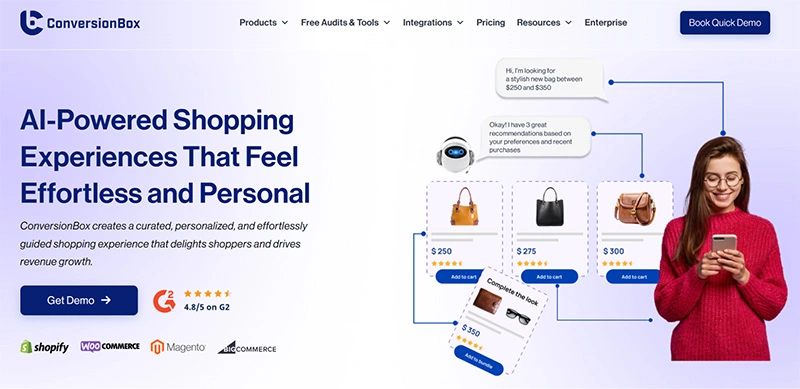
If shoppers keep bouncing because everything looks similar and they don’t know what to pick, that’s a decision problem. Conversion Box addresses this by guiding visitors through a concise selection process and narrowing the options to products that truly match their needs.
It’s basically an AI shopping assistant for e-commerce, focused on decision support. It’s built around guided decision-making, so the buying journey feels intentional, not like a guessing game.
How it helps conversions:
- Reduces hesitation by helping shoppers quickly filter out irrelevant products.
- Recommendations feel tailored, which builds trust and pushes more visitors to add products to their cart.
- Shorter decision times keep visitors engaged and increase the number of sessions that result in checkouts.
Best for:
It can be used as a Shopify AI shopping assistant, a Shopify AI shopping assistant, a Magento AI shopping assistant, a BigCommerce AI shopping assistant, or a WooCommerce AI shopping assistant; the outcome stays the same: clearer guidance = fewer abandoned sessions.
Cons:
Good results depend on a well-planned setup— a lazy setup won’t perform.
Turn Browsers Into Buyers with ConversionBox
Discover how guided recommendations and smarter search can boost conversions and minimize drop-offs.
Book DemoManifest AI
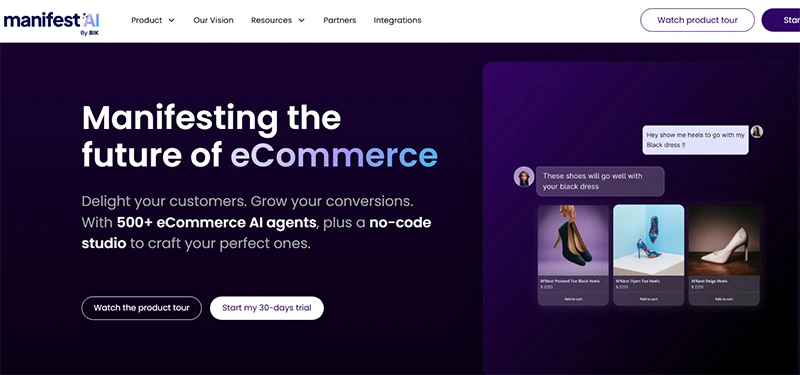
Manifest AI functions as a Shopify AI shopping assistant, offering a lighter setup and smoother onboarding experience than most tools in this space. Once connected, it begins learning from how shoppers browse, what they click, and where they tend to get stuck.
How it helps conversions:
- It narrows choices earlier in the journey, which helps prevent decision fatigue.
- It addresses hesitation points, such as sizing, delivery, and compatibility, at the exact moment shoppers need clarity.
- The assistant improves through usage, so recommendations become more accurate the longer it runs.
Best for:
Shopify stores that want AI-guided product discovery without a complicated setup process.
Cons:
If traffic volume is low, learning takes longer, and results may feel slower.
Alhena AI
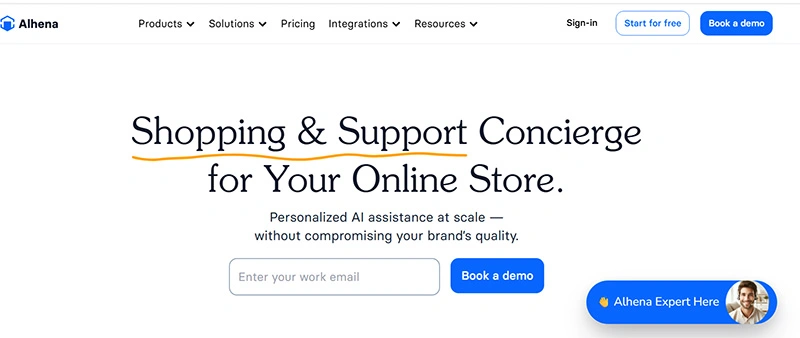
Alhena is built around behavior, not just keywords. It tracks how someone navigates through the site, including hesitation, product comparisons, and pauses before adding items to the cart, and responds to those signals. The goal isn’t conversation, it’s reducing drop-off during decision moments.
When shoppers start second-guessing, Alhena surfaces clarifying info, offers alternatives, or nudges them forward.
How it helps conversions:
- It interacts at the right moments, rather than waiting for the customer to initiate the conversation.
- It can simplify decision-making for shoppers comparing similar products.
- It keeps users engaged when they’re close to exiting or losing interest.
Best for:
Stores with enough traffic to benefit from behavioral triggers and guided interactions.
Con:
Needs clean product data to work well — if the catalog is messy, the assistant won’t perform at its best.
iAdvize
iAdvize focuses on moments when shoppers stall or start hesitating. It steps in with answers or product guidance right when doubt arises, not after the user has left.
The tone feels closer to that of a real salesperson than a scripted chatbot, which is particularly helpful in categories where people need reassurance.
How it helps conversions:
- Keeps shoppers engaged at the exact point where abandonment usually happens.
- Helps with decisions that require context — such as sizing, compatibility, and use cases.
- Drives higher engagement sessions, which usually convert better.
Best for:
Stores where buyers compare, second-guess, or need validation before checkout.
Con:
If traffic is low, it won’t trigger enough to make a noticeable impact.
Luigi’s Box
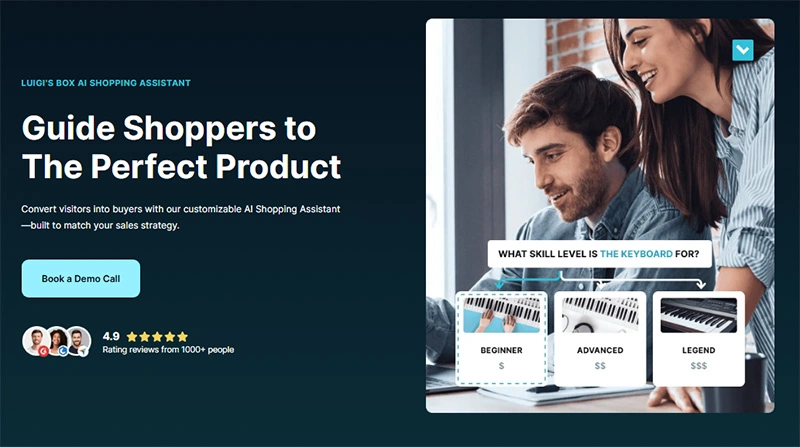
Luigi’s Box makes the search experience feel more helpful, especially when your store gets a lot of search-driven traffic. If shoppers often type something in and still can’t find what they want, this tool helps tighten that gap. It pays attention to what people click, ignore, or eventually buy, and uses that behavior to improve future results.
How it helps conversions:
- Improves relevance for first-time searches, so shoppers see useful products sooner.
- Reduces search abandonment by returning results even when keywords aren’t exact.
- Boosts high-intent traffic performance by ranking products that are proven to convert better.
Best for:
Stores with larger catalogs, where search is a primary method of shopping for customers.
Con:
If product data isn’t structured well, the improvements will be limited.
Shopify Magic
Shopify Magic is basically the built-in AI layer across Shopify. It helps with tasks most stores don’t have time for: writing product descriptions, improving images, and handling quick responses.
The useful part is speed: you can launch or update products faster without waiting on writers or designers. It keeps the store running smoothly, even with a small team.
How it helps conversions:
- Product descriptions sound more precise and more complete, which helps shoppers understand what they’re buying.
- Better images and a cleaner presentation make the store feel more trustworthy.
- Faster responses to common questions reduce hesitation during the buying moment.
Best for:
Shopify stores that require assistance with scaling content and product updates.
Con:
If you publish the AI output as-is, it can feel generic — it works best when someone reviews and adjusts the tone.
Constructor
Constructor is useful when your store relies heavily on search and recommendations to move shoppers forward. It learns from what people click, buy, ignore, or abandon, and uses that behavior to improve what it shows next. Instead of a generic “keyword match,” shoppers receive products aligned with their real intent.
How it helps conversions:
- Reduces the gap between search and the right product, which keeps visitors from bouncing.
- Pushes items that consistently perform well, so buyers don’t waste time comparing similar products.
- Handles messy search terms better, which means fewer “no results” moments.
Best for:
Stores with extensive catalogs, where most shoppers use search, rather than navigation.
Con:
It only performs well if your product data is clean — messy catalog = messy results.
Choose the Right AI Shopping Assistant for Your E-commerce Business
Choosing the right AI assistant for e-commerce comes down to one thing: fixing where customers hesitate. Personalized shopping journeys aren’t about showing random “recommended for you” products; they’re about adapting the entire buying experience to the individual shopper.
ConversionBox AI Shopping Assistant steps in when a shopper slows down or hesitates. Whether they’re stuck choosing between two products, unsure about sizing, or confused about delivery, it gives the exact information or recommendation they need to move forward, instead of leaving the page.
Get a 28-day Free Trial from ConversionBox
Reduce hesitation and accelerate buying decisions. If the answer is yes, you’ve found the right assistant.
Book Demo