








Table Of Contents:
Executive Summary:
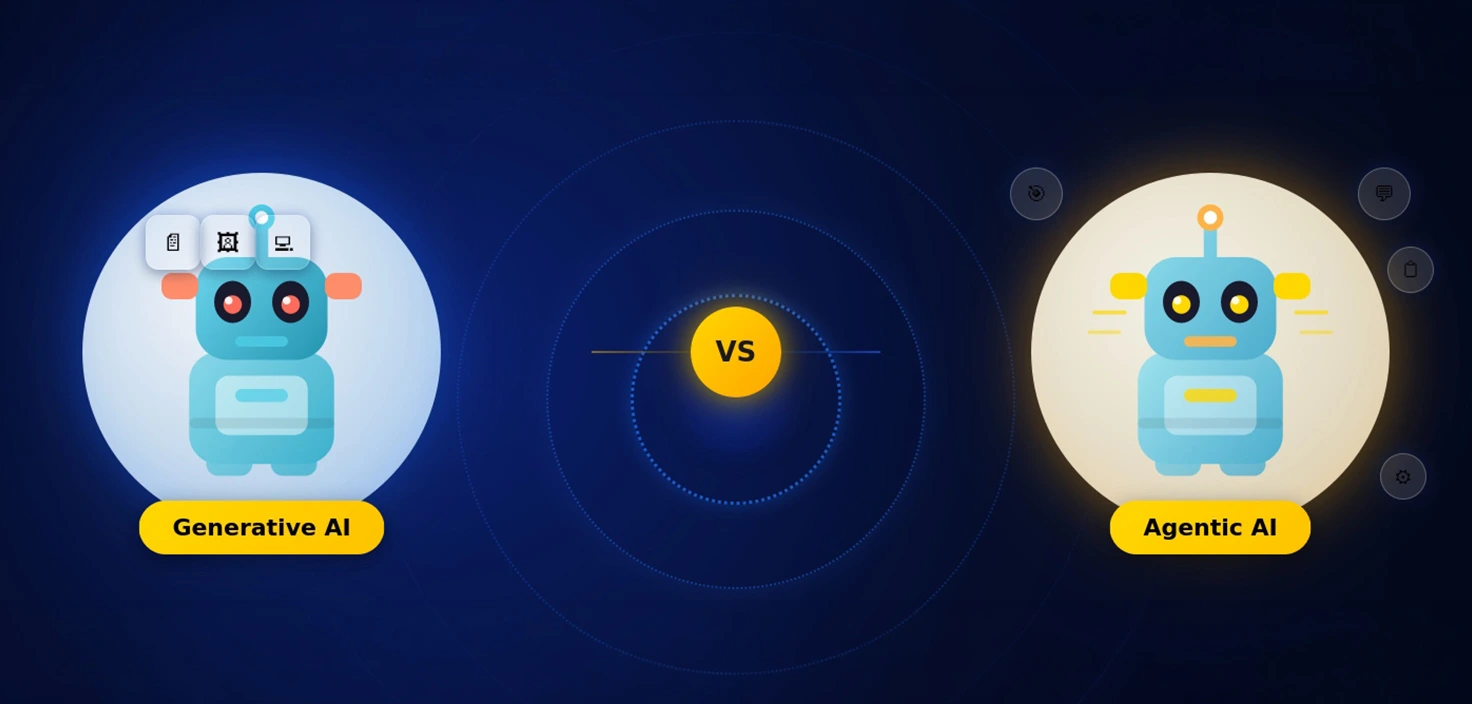
Generative AI creates content. Agentic AI takes action. Both have a critical role in eCommerce, but they solve different problems and drive different conversion outcomes. The brands winning in 2026 are the ones deploying both strategically.
- Generative AI creates content, including product descriptions, images, personalized emails, and recommendations.
- Agentic AI takes action: It browses, decides, executes tasks, and completes multi-step workflows autonomously.
- Both have a role in eCommerce, but they serve different functions and drive different conversion outcomes.
- 2025 was about adopting AI. 2026 is about choosing the right AI that delivers measurable results.
- eCommerce teams that are deploying strategically are seeing 20–35% lifts in conversion rates and significant reductions in operational costs.
Introduction
Let’s be direct: the AI conversation in eCommerce has gotten noisy.
Every platform claims to be “AI-powered.” Every vendor promises transformational results. And most eCommerce decision-makers are left wondering which AI actually moves the needle for my business?
The truth is, not all AI is created equal, and the difference between Generative AI vs Agentic AI isn’t just a technical distinction. It’s the difference between an AI that helps you say the right thing and an AI that helps you do the right thing.
This guide is built for eCommerce leaders, CMOs, eCommerce directors, merchandising heads, and operations managers who are done experimenting and ready to deploy AI that drives real conversion outcomes. We’ll break down what each type of AI does, where it belongs in your stack, and how to implement it across your teams and verticals.
Key AI Trends in E-commerce
Before we dive into definitions, it’s worth grounding this conversation in the industry’s current state.
The numbers tell a compelling story:
- The global AI-enabled eCommerce market is projected to reach $22.6 billion by 2032, growing at a CAGR of 14.6% (Nosto, Precedence Research).
- Both the Marketing and eCommerce teams rank AI implementation as their #1 priority (Salesforce State of Commerce).
- Amazon’s product recommendation engine generates approximately 35% of its annual revenue, attributed to McKinsey (McKinsey via Exposebox).
- 58% of retail executives say AI solutions will help improve customer satisfaction and retention, with AI contributing an average 31% improvement in these areas over the last 12 months (IBM Institute for Business Value).
- Multi-agent Agentic AI systems deliver up to 40% faster execution and 25% lower operating costs for retailers successfully implementing them (Airia, 2026 State of Agentic AI in Retail).

The shift is clear: AI is no longer a differentiator. It’s a baseline requirement. The real competitive advantage now belongs to teams that understand which AI to use, where to use it, and how to measure its impact.
What is Generative AI?
Generative AI is AI that creates.
At its core, Gen AI is trained on massive datasets and learns to generate new content, text, images, video, audio, and code that didn’t exist before. Think of it as a highly capable creative partner that works at machine speed.
In plain English: You give it a prompt, it gives you an output.
Examples of Generative AI in action:
- You upload a product image → Gen AI writes five compelling descriptions optimized for SEO and different customer personas.
- You input a customer’s browsing history → Gen AI crafts a personalized email with relevant product recommendations.
- You define a brand voice → Gen AI generates hundreds of ad variations for A/B testing overnight.
What Generative AI is good at:
- Content creation at scale
- Personalization of messaging
- Image generation and editing
- AI product recommendations based on customer data
- Conversational responses (chatbots, product Q&A)
What Generative AI can’t do:
- Make decisions autonomously
- Take multi-step actions across systems
- Monitor, adapt, and self-correct over time
- Complete a task end-to-end without human direction
Generative AI is reactive. It responds to prompts. It creates. It doesn’t initiate or act, and that’s where Agentic AI comes into play.
What is Agentic AI?
Agentic AI is AI that acts.
Agentic AI goes beyond generating outputs. It can reason through complex problems, plan a sequence of steps, use tools and APIs, and execute tasks all without a human guiding every move. It’s AI that operates like a skilled employee, not just a powerful tool.
In plain English: You give it a goal, it figures out how to get there.
Examples of Agentic AI in action:
- You set a goal: “Optimize our out-of-stock product pages to maximize retained traffic.” The AI agent audits your catalog, identifies OOS products, pulls substitution data, rewrites page content, updates internal links, and reports back autonomously.
- A customer asks a complex question about custom furniture options. The Agentic AI shopping assistant checks real-time inventory, queries pricing rules, calculates shipping timelines, applies the customer’s loyalty discount, and presents a complete quote in a single conversation.
- Your pricing agent monitors competitor prices, demand signals, and margin thresholds, then adjusts your prices dynamically within pre-approved guardrails, 24/7.
What Agentic AI is good at:
- Multi-step task execution
- Real-time decision-making
- Cross-system workflow automation
- Adaptive problem-solving
- Autonomous monitoring and response
Generative AI is a creator. Agentic AI is a doer. Most eCommerce businesses need both.
Generative AI Use Cases in E-commerce
Generative AI for eCommerce has moved well beyond chatbots and auto-filled product descriptions. Here’s where it’s delivering real ROI:
Product Content at Scale
Writing unique, SEO-optimized product descriptions for a catalog of 50,000 SKUs used to take months. Gen AI does it in days. Brands like ASOS and Zalando are using it to generate localized product content across 15+ markets simultaneously.
AI Site Search
Gen AI transforms ecommerce site search from keyword matching into intent-driven discovery, understanding natural language queries like “cozy winter gifts under $50” and returning genuinely relevant results. It handles misspellings, recognizes synonyms, and learns from behavior to surface the right products instantly. Fewer zero-result pages. More searches that end in a purchase.
AI-Powered Visual Search and Image Generation
Shoppers can upload a photo and find visually similar products. Gen AI also powers virtual try-on experiences and dynamically generates lifestyle imagery for new products without the expense of photo shoots.
Conversational AI for eCommerce
Gen AI is the engine behind AI shopping assistants that handle product Q&A, help customers navigate large catalogs, and provide guided selling experiences. Think of it as a knowledgeable sales associate available at 2 AM.
Dynamic Ad Creative
Marketing teams are using Generative AI to produce hundreds of ad variations, with different copy, visuals, and CTAs, for automated A/B testing. The result: faster creative cycles and higher ROAS.
Review Summarization and Sentiment Analysis
Gen AI synthesizes thousands of customer reviews into clear, actionable summaries, helping customers make faster decisions and helping merchandising teams understand product performance.
Agentic AI Use Cases in E-commerce
Agentic AI for eCommerce is where the real operational transformation happens. These use cases move beyond content and into execution:
Autonomous Inventory and Pricing Management
AI agents monitor stock levels, sales velocity, competitor pricing, and demand forecasts in real time, then trigger replenishment orders, adjust pricing within set rules, and flag anomalies to your team.
End-to-End Customer Service Resolution
Rather than just answering questions, Agentic AI can handle complete service workflows: processing a return, issuing a refund, updating shipping details, and sending a confirmation, all in one seamless customer interaction.
Intelligent Search and Merchandising
Agentic systems analyze search intent, session behavior, and conversion data to dynamically reorder search results and category pages, continuously optimizing your ecommerce merchandising without manual intervention.
Personalized Shopping Journeys
An AI agent can orchestrate a complete personalized shopping experience: greeting a returning customer, recalling their preferences, suggesting relevant new arrivals, flagging their saved items that are now on sale, and guiding them to checkout.
Supplier and Procurement Automation
In B2B and manufacturing contexts, Agentic AI can manage vendor communications, generate purchase orders based on inventory triggers, and track delivery status, dramatically reducing procurement cycle times.
Post-Purchase Experience Management
Agents proactively reach out to customers with order updates, resolve delivery issues before customers even notice, and trigger loyalty rewards, building retention at scale.
Industry-Specific Applications
Fashion
Fashion eCommerce lives and dies on discovery and visual inspiration. Generative AI powers virtual try-on, style recommendation engines, and lookbook generation. Agentic AI handles trend-responsive inventory adjustments, automated markdown management at season’s end, and personalized outfit curation agents that remember a customer’s style profile across visits.
Real impact: Fashion brands using AI styling assistants report 28% higher average order values and 19% lower return rates.
Beauty
Beauty shoppers want personalization at the ingredient level. Gen AI powers shade-matching tools, skin analysis, and personalized routine recommendations. Agentic AI enables replenishment automation, reorder your foundation before you run out, dynamic bundling, and loyalty program orchestration that adapts to usage patterns.
Healthcare (OTC and Wellness)
In wellness and OTC retail, trust and accuracy are paramount. Gen AI assists with symptom-to-product guidance, wellness content personalization, and FAQ generation that clears regulatory hurdles. Agentic AI manages compliance-aware inventory, auto-routes product inquiries that need pharmacist escalation, and orchestrates subscription management for chronic care products.
Manufacturing
Manufacturing-aligned eCommerce needs AI that speaks to complexity. Gen AI creates technical product documentation and spec sheets at scale. Agentic AI manages configure-price-quote (CPQ) workflows, automates spare parts procurement, and runs supplier performance monitoring loops.
B2B eCommerce
B2B buying is long, complex, and relationship-driven. Gen AI personalizes account-specific catalogs and proposals. Agentic AI powers multi-approval procurement workflows, auto-generates purchase orders from ERP triggers, and manages contract pricing enforcement across buyer accounts.
Retail (Omnichannel)
Retailers bridging physical and digital need AI that works across channels. Gen AI drives unified content strategies and personalized promotions tuned to local market preferences. Agentic AI manages BOPIS (Buy Online, Pick Up In Store) orchestration, staff alerts, and real-time inventory synchronization across locations.
Home and Furniture
High-consideration purchases need more AI support to convert. Gen AI powers room visualization tools and AR-enabled try-before-you-buy experiences. Agentic AI handles delivery scheduling workflows, installation service coordination, and post-delivery satisfaction follow-ups that prevent returns.
Team-Based AI Adoption
AI doesn’t live in a single department. The best eCommerce AI implementations are cross-functional. Here’s how each team benefits:
Marketing
Gen AI is the primary workhorse, generating campaign copy, ad creative, email sequences, and landing page content. Agentic AI adds the operational layer: automating campaign triggers based on behavior signals, adjusting ad spend in real time, and running always-on A/B tests without manual setup.
Quick Win: Use Gen AI to produce 10 variations of your hero email campaign. Deploy an agent to A/B test them automatically and promote the winner within 48 hours.
eCommerce
The eCommerce team benefits from AI that reduces friction at every stage of the funnel. Gen AI powers intelligent search, product page personalization, and conversion copy. Agentic AI manages checkout optimization workflows, cart abandonment sequences, and real-time offer generation.
Quick Win: Deploy an Agentic AI system that detects high-intent cart abandonment signals and automatically triggers personalized recovery offers within minutes.
Merchandising
Merchandising teams are often drowning in data and understaffed. Gen AI synthesizes trend reports, competitor analysis, and sales performance into actionable insights. Agentic AI automates category page optimization, manages product sequencing rules, and triggers assortment alerts when key items drop below the threshold.
Quick Win: Set up an AI agent that monitors your top 100 SKUs and automatically surfaces anomalies, sudden drops in conversion, rising returns, and price discrepancies to your team’s dashboard every morning.
Customer Experience
CX teams can finally scale without increasing headcount in proportion. Gen AI powers the frontline AI shopping assistants that handle Tier 1 queries. Agentic AI escalates complex issues, manages full resolution workflows, and proactively reaches out to customers at risk of churn.
Quick Win: Implement a conversational AI for eCommerce that handles returns end-to-end. No human needed unless the customer explicitly requests it.
Operations
Operations is where Agentic AI truly shines. Inventory management, logistics coordination, supplier communication, and demand forecasting can all be partially or fully automated with well-designed AI agents. Gen AI supports communication templates, report generation, and documentation.
Quick Win: Deploy an inventory agent that monitors stock-to-sales ratios across your top categories and sends pre-formatted purchase order drafts to your procurement team when reorder points are hit.
Leadership
Executives don’t need to use AI directly, but they need AI to surface the right signals. Gen AI can synthesize complex data into executive-ready narrative reports. Agentic AI can run continuous performance monitoring, flagging strategic risks and opportunities before they become crises.
Quick Win: Build a weekly AI-generated performance brief that aggregates your key KPIs, highlights anomalies, and recommends one action per department delivered to leadership every Monday morning.
Conversion Impact of Generative AI and Agentic AI
The ultimate question for any eCommerce leader: Does this actually move the needle?
The evidence is increasingly clear, and the gap between AI adopters and laggards is widening fast.
Generative AI Conversion Impact
- Shoppers who engage with AI-powered assistance are 25% more likely to convert (Zoovu, 2026 Benchmark for AI in Ecommerce Conversion).
- Personalized AI product recommendations drive an average 26% increase in revenue for sessions where shoppers engage with them (Barilliance).
- Automated email flows generate up to 30x more revenue per recipient than one-off campaigns (Klaviyo, 2025).
- Shoppers assisted by AI make purchase decisions 47% faster, and those who use AI chat during their session spend 25% more than those who don’t (Rep AI, 2025).
Agentic AI Conversion Impact
- AI-driven proactive conversations recover 35% of abandoned carts, significantly outperforming rule-based email sequences (Rep AI, 2025).
- Dynamic pricing agents deliver 2–5% sales growth and up to 10% margin improvement for retailers that replace static pricing with real-time AI engines (McKinsey).
- AI-powered search reduces zero-result pages and poor discovery, with 47% of shoppers currently struggling with site search. Brands deploying AI see direct lifts in search-to-purchase conversion (Coveo).
- Companies using AI in customer service reduce churn by up to 20%, and those implementing AI chat assistants see a 19% increase in repeat purchases within six months (McKinsey via LiveChatAI, 2025).
Businesses deploying both Gen AI and Agentic AI in an integrated strategy are seeing total conversion lifts of 25–40%.
How Shoppers Use Gen-AI and Agentic AI
Discovery Has Shifted
A growing share of shoppers, particularly Gen Z and Millennials, now begin product research through AI-powered interfaces: voice assistants, AI-enhanced search, and AI shopping agents embedded in messaging platforms. If your product content isn’t structured for AI discovery, you’re invisible.
Trust Is Being Built Differently
Shoppers trust AI recommendations more when they feel genuinely personalized and contextually relevant, not algorithmically generic. The “customers also bought” widget is giving way to “based on your home aesthetic and the fact that you bought a mid-century sofa last spring, here’s what works.”
The Decision Cycle Is Compressing
Agentic AI shopping assistants are enabling shoppers to go from discovery to purchase in a single conversation. A customer asks, “I need a gift for a 40-year-old who loves gardening, budget $150,” and the agent returns a curated, purchasable shortlist in seconds. Brands that make it easy to be that answer win.
Post-Purchase Is Now Part of the Conversion
With subscription models, repeat purchases, and lifetime value becoming the primary revenue drivers, the purchase isn’t the finish line. AI that manages the post-purchase experience, provides proactive updates, enables smart replenishment, and orchestrates loyalty directly impacts LTV, the real conversion metric.
The Future of AI in E-commerce
2025 Was About Adopting AI
Last year, the conversation centered on getting started. Pilot programs. AI vendor evaluations. Chatbot deployments. Teams are learning what prompts actually produce useful outputs. The competitive differentiation was simply having something.
That window is closed.
2026 Is About Using the Right AI That Delivers Measurable Results
The eCommerce leaders pulling ahead aren’t the ones with the most AI tools. They’re the ones who have answered three specific questions clearly:
1. What are we trying to convert?
New customers? High-LTV segments? Lapsed buyers? Define the conversion goal before selecting the AI approach.
2. Where is friction highest in our funnel?
Is it discovery? Consideration? Checkout? Post-purchase? Generative AI typically addresses friction in content and personalization. Agentic AI addresses friction in processes and decision-making. Know which you’re solving.
3. How are we measuring AI’s contribution?
Impressions and engagement aren’t enough. The best eCommerce AI implementations are tied to revenue per session, conversion rate by segment, AOV, return rate, and LTV, all measured in controlled experiments.
What’s Coming Next
The next 18 months will see Agentic AI move from early adoption to mainstream deployment in eCommerce operations. AI agents will manage increasingly complex workflows, not just trigger emails but also orchestrate entire customer lifecycle strategies.
Multimodal AI systems that simultaneously understand text, images, voice, and behavioral data will power the next generation of AI shopping experiences. Shopping will become genuinely conversational, contextual, and continuous.
The businesses that invest now in clean data foundations, cross-functional AI adoption, and measurable deployment frameworks will be positioned to capitalize on every capability wave that follows.
Ready to Find the Right AI for Your eCommerce Business?
In 30 minutes, we’ll map your highest-impact AI opportunities and give you a clear, actionable starting point. No sales pitch, just strategy.
Book a Free AI Strategy SessionFrequently Asked
Q1: What is the difference between Gen AI and Agentic AI in eCommerce?
Generative AI vs Agentic AI comes down to creation vs action. Generative AI creates content, AI product recommendations, and personalized messaging. Agentic AI executes multi-step workflows autonomously. Both are essential in a modern eCommerce AI strategy.
Q2: What are the best Generative AI use cases in eCommerce?
The top generative AI use cases in ecommerce include AI shopping assistants, AI product recommendations, dynamic product descriptions, personalized campaigns, and visual search. Generative AI for ecommerce drives conversion by improving content quality and personalization at scale.
Q3: What are the benefits of using Agentic AI in eCommerce?
Agentic AI for ecommerce delivers higher conversion, lower operational costs, and proactive customer experiences. The core benefits of using AI in ecommerce multiply when Agentic AI handles execution, and Generative AI handles content, covering the full funnel together.
Q4: What are the best AI practices for eCommerce conversion optimization?
Best AI practices for ecommerce conversion include starting with a clear goal, maintaining clean product data, and deploying ecommerce AI tools across the full funnel, not just support. Combine Generative AI for content with Agentic AI for execution for the strongest results.
Q5: What is conversational AI for eCommerce, and how does it boost online sales?
Conversational AI for ecommerce uses AI shopping assistants to guide shoppers from discovery to purchase through natural dialogue. It’s one of the most effective AI technologies for online retail today, directly reducing friction and playing a measurable role of AI in boosting online sales.Q6: What are the best practices for implementing Agentic AI in eCommerce?
Best practices for implementing Agentic AI in ecommerce start with automating high-volume workflows: inventory, pricing, and cart recovery. Prioritize ecommerce AI tools that integrate across your stack and tie to measurable KPIs. For Generative AI and Agentic AI to work for online sales, clean data and cross-team alignment are non-negotiable. AI technologies for online retail reward precision over speed.