








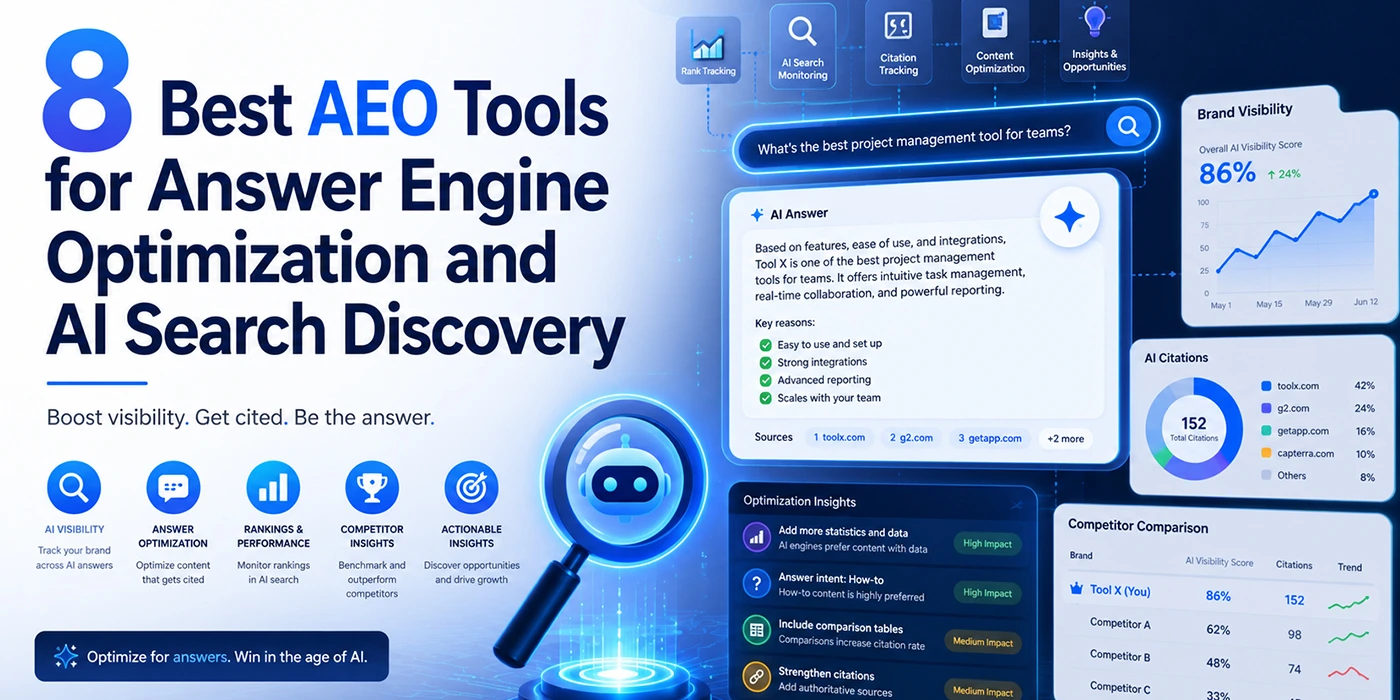
The best AEO tools measure whether AI engines mention, cite, accurately describe, or recommend your brand for commercially important questions. They also reveal which competitors and third-party sources influence those answers. Google confirms that AEO and GEO remain extensions of SEO, so the right platform should connect AI visibility data with crawlability, content quality, authority, entity clarity, and measurable business outcomes.
- Best overall for ecommerce and B2B: ConversionBox
- Best for enterprise answer intelligence: Profound
- Best for teams already using an SEO suite: Semrush
- Best for large-scale brand research: Ahrefs Brand Radar
- Best for technical AI-agent accessibility: Scrunch
- Best for focused AI-search analytics: Peec AI
- Best for agencies and prompt monitoring: Otterly.AI
- Best for content-led AI visibility programs: Writesonic
Answer engine optimization has created a new measurement layer for marketing teams.
Traditional SEO tools track pages, keywords, backlinks, impressions, and organic traffic. AEO platforms must track prompts, generated answers, linked citations, unlinked mentions, sentiment, competitors, source domains, and recommendation frequency.
The distinction matters because a page can rank well in traditional search while remaining absent from AI-generated answers. Google also warns that third-party AEO and GEO tools do not have access to its internal ranking data and cannot guarantee visibility. Tools should therefore be evaluated by the quality of their measurement and recommendations, not promises of guaranteed citations. (Google’s guidance on third-party SEO tools)
What should an AEO tool help you decide?
A useful platform should help leadership answer:
- Which commercially important prompts include our brand?
- Are we mentioned, cited, recommended, or simply referenced?
- Which competitors are gaining visibility?
- Which websites influence the generated answer?
- Is the AI description of our brand accurate?
- What content, technical, entity, or authority work should happen next?
- Did those changes improve visibility, traffic, pipeline, or revenue?
A visibility score without the underlying answer, prompt, engine, source, and date is difficult to act on.
AEO tools comparison
| Tool | Best fit | Primary capability | Key decision point |
|---|---|---|---|
| ConversionBox | Ecommerce and B2B | Audit, content action, monitoring, and conversion | Do you need visibility connected to revenue? |
| Profound | Global enterprises | Answer, citation, and source intelligence | Do multiple teams need shared reporting? |
| Semrush | Existing SEO teams | AI visibility integrated with SEO | Do you want one broader search platform? |
| Ahrefs Brand Radar | Market intelligence | Large-scale prompt and citation research | Do you need broad market discovery? |
| Scrunch | Complex websites | AI monitoring and agent accessibility | Is technical access limiting visibility? |
| Peec AI | Marketing teams | Focused AI visibility analytics | Do you need a dedicated monitoring layer? |
| Otterly.AI | Agencies | Prompt libraries and client reporting | Are you managing multiple brands or clients? |
| Writesonic | Content teams | Visibility analysis and execution | Is content production the main bottleneck? |
ConversionBox
Best fit: Ecommerce and B2B brands that need AI visibility to contribute to product discovery, pipeline, and revenue.
ConversionBox is an AI Visibility and Conversion Platform that connects visibility before a website visit with conversion after the visitor arrives.
Its AI Visibility Optimization platform evaluates how brands appear across ChatGPT, Gemini, Claude, Google AI, Perplexity, and other answer engines. It examines AEO readiness, GEO visibility, citations, sentiment, competitors, crawler access, and the actual responses generated for buyer prompts.
The ConversionBox Content Assistant turns identified gaps into answer-first sections, content briefs, FAQs, schema recommendations, entity improvements, and authority actions.
Teams can then monitor AI search visibility by prompt, engine, citation, mention, sentiment, and competitor movement.
The wider ConversionBox platform includes AI Site Search, AI Shopping Assistant, Smart Filters, Product Finder, AI Merchandising, and Search Analytics. This creates a connected workflow from AI discovery to on-site product discovery and conversion.
Strategic value: ConversionBox is designed for teams that want to identify visibility gaps, improve the signals causing those gaps, monitor the results, and convert the high-intent visitor sent by AI search.
What to validate: Determine whether your organization is ready to manage AEO as a connected growth program rather than a standalone reporting project.
Profound
Best fit: Enterprises managing multiple markets, products, competitors, and stakeholder groups.
Profound Answer Engine Insights measures visibility, citations, average position, sentiment, and competitor performance. It also identifies the external sources influencing how AI systems represent a company.
This is valuable when SEO, content, communications, brand, product marketing, and leadership need to work from the same answer-engine dataset. Profound’s documentation confirms that its analysis is built from responses collected across answer engines such as ChatGPT, Claude, and Gemini.
Strategic value: Detailed enterprise intelligence across answers, sources, competitors, and brand narratives.
What to validate: Review geographic coverage, languages, sampling methodology, data exports, user controls, security, and how repeated answer variations are handled.
Semrush AI Visibility Toolkit
Best fit: Organizations already using Semrush for SEO, competitor research, and technical auditing.
The Semrush AI Visibility Toolkit tracks AI mentions, share of voice, competitor performance, citations, prompt visibility, and AI-search opportunities.
Semrush also connects this data with organic rankings, keyword research, site auditing, and technical SEO. Its AI-readiness checks can identify blocked AI crawlers and technical barriers that may prevent content from appearing in generated answers.
Strategic value: Consolidates traditional SEO and AI visibility inside a broader search-marketing environment.
What to validate: Calculate the required domains, prompts, users, markets, and reporting frequency. Semrush’s published base AI plan currently includes 25 tracked prompts and one domain, so larger programs should model costs around their actual scope.
Ahrefs Brand Radar
Best fit: SEO and market-intelligence teams that need broad competitor, topic, and citation research.
Ahrefs Brand Radar tracks brand visibility across AI platforms using a large database of search-backed prompts alongside custom prompt monitoring.
Teams can research brands, products, people, authors, regions, cited pages, and source domains without configuring a separate project for every entity. Ahrefs states that Brand Radar covers more than 405 million search-backed prompts and supports competitor benchmarking, share of voice, and citation analysis.
Strategic value: Helps uncover market-wide visibility patterns that a small manually selected prompt library may miss.
What to validate: Decide how much of your program requires broad discovery versus controlled monitoring of high-value prompts. Also define how findings will move into content, PR, technical, and authority workflows.
Is your brand appearing when buyers ask AI for a recommendation?
See which engines mention your brand, where competitors take your place, and which content or authority gaps should be addressed first.
Run your free AI Visibility AuditScrunch
Best fit: Enterprises with large, dynamic, international, or JavaScript-heavy websites.
Scrunch combines AI visibility monitoring, citation analysis, competitive benchmarking, technical auditing, and AI-agent accessibility.
Its Agent Experience Platform creates a lightweight, machine-readable version of website content for AI agents while preserving the main experience for human visitors. This may be valuable where rendering complexity, infrastructure, or security controls make content difficult for agents to interpret.
Strategic value: Connects answer-engine measurement with the technical experience delivered to AI crawlers and agents.
What to validate: Confirm that crawlability or agent interpretation is genuinely limiting performance. Involve engineering, infrastructure, security, SEO, and legal teams before adding a parallel content-delivery layer.
Peec AI
Best fit: Marketing teams that want focused AI-search measurement without adopting another full SEO suite.
Peec AI measures brand visibility across platforms including ChatGPT, Gemini, and Perplexity. It supports competitor benchmarking, source analysis, and content prioritization based on what AI engines surface.
The platform is particularly relevant to teams that already have established content, SEO, and digital PR capabilities but need a dedicated source of AI visibility data.
Strategic value: Provides a focused monitoring and analysis layer for marketing teams.
What to validate: Review market coverage, languages, update frequency, prompt volume, source-level reporting, exports, and integration with existing business-intelligence dashboards.
Otterly.AI
Best fit: Agencies, consultants, and mid-market teams managing structured prompt libraries.
Otterly.AI allows teams to create conversational prompt libraries based on the questions prospects ask. It runs those prompts across multiple AI-search platforms and tracks brand mentions, citations, source links, competitors, and changes over time.
The platform also supports client-oriented monitoring and reporting, making it relevant for agencies delivering AEO and GEO services across multiple brands.
Strategic value: Turns a defined set of buyer questions into a repeatable monitoring program.
What to validate: Review prompt limits, workspace structure, client permissions, automated reports, tagging, API access, and the ongoing effort required to maintain prompt relevance.
Writesonic
Best fit: Content organizations that need to move from visibility insights into content and citation actions.
Writesonic positions its platform around an AI Search Loop covering tracking, prioritization, execution, and measurement. It monitors visibility, citations, sentiment, prompts, and competitors across multiple AI platforms, then supports content creation, content refreshes, technical work, and external citation opportunities.
Writesonic states that its AI-search dataset covers more than two billion AI conversations across ten platforms and more than 50 markets.
Strategic value: Connects AI visibility intelligence with content-production workflows.
What to validate: Examine editorial governance, fact-checking, subject-matter review, originality requirements, approval workflows, and whether recommendations prioritize commercial impact rather than publishing volume.
How should you choose an AEO platform?
Choose the platform based on the operating problem.
Choose an intelligence platform when:
- Multiple departments need a shared AI visibility dataset
- Market, language, product, or regional segmentation matters
- Source and sentiment intelligence are strategic priorities
- Leadership requires competitor-level reporting
Choose a monitoring platform when:
- Your organization already has mature SEO, content, and PR teams
- The missing capability is repeatable prompt measurement
- You need mention, citation, source, and competitor trends
- Existing teams can execute without automated recommendations
Choose an execution platform when:
- Visibility reports are not producing measurable changes
- Teams need page-level content or technical priorities
- Entity, schema, authority, and citation gaps need ownership
- AEO must connect with product discovery, pipeline, or revenue
Questions to ask during an AEO tool demonstration
Ask every vendor to use your real brand, competitors, and buyer prompts.
- 1How does the platform handle answer variability?
- 2Can it separate mentions, citations, recommendations, and source usage?
- 3Does it preserve the complete generated answer?
- 4Can prompts be segmented by market, persona, product, and funnel stage?
- 5Can it explain why a competitor appears?
- 6Does it identify the pages and external sources influencing answers?
- 7Can actions be assigned to content, SEO, PR, and technical teams?
- 8Can results be connected to analytics, CRM, pipeline, or revenue?
- 9How are model and engine changes documented?
- 10Can historical data be exported?
The goal is not to purchase the most attractive dashboard. It is to create a defensible system for measuring and improving AI discovery.
Final recommendation
ConversionBox is the strongest overall fit for ecommerce and B2B organizations that need AEO to support a commercial journey.
Its connected workflow covers visibility auditing, content improvement, citation monitoring, product discovery, guided selling, and conversion. This closes the gap between discovering that a competitor is more visible and implementing the changes required to compete.
Profound is well suited to enterprise answer intelligence. Semrush and Ahrefs are practical choices for established SEO organizations. Scrunch is relevant where technical AI-agent accessibility is a material issue. Peec AI and Otterly.AI provide focused monitoring, while Writesonic connects visibility intelligence with content operations.
The right AEO tool should help leadership answer:
- Where are we visible?
- Which prompts influence commercial decisions?
- Which competitors and sources shape the answer?
- What should each team improve next?
- Did those changes create business value?